Gluten-Free at a Potluck: What to Bring and How to Handle the Table
Quick Answer: A potluck is harder than a restaurant because there is no chef, no ingredient list, and serving spoons move between dishes constantly. Three rules handle almost all of it: bring one substantial gluten-free dish you can make a meal from, serve yourself first before spoons have migrated, and do not interrogate other people’s food - assume anything unlabelled is not safe and eat around it. If you have coeliac disease rather than a sensitivity, the cross-contamination risk on a shared table is real and plating from the kitchen before service starts is the version that actually works.
Autumn is potluck season - fall gatherings, football watching, holiday run-ups - so this comes up more from now until January than the rest of the year combined.
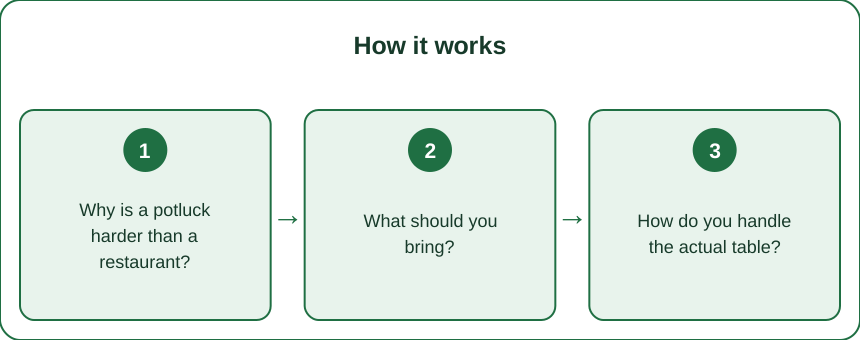
Why is a potluck harder than a restaurant?
Because every safeguard that exists in a restaurant is absent.
No ingredient information. A dish arrives in a casserole with no label and no list. Soy sauce, stock cubes, thickened sauces, malt vinegar, and breadcrumb binders are the standard hidden sources and they are invisible in a finished dish.
No one to ask, reliably. The person who made it is present, which sounds better than a restaurant, but home cooks genuinely do not know that their stock cube contains wheat or that their sauce was thickened with flour. A confident no is not the same as an informed no.
Serving utensils migrate. This is the biggest practical difference. Within twenty minutes of a potluck starting, the spoon from the pasta salad has been in three other dishes. Cross-contamination on a shared table is not hypothetical, it is close to guaranteed.
Bread is everywhere and it sheds. Rolls, garlic bread, crackers on a board. Crumbs travel onto every adjacent surface, and people handle bread then serve themselves from a communal dish.
The buffet queue makes hesitation visible. Standing over a dish trying to work out what is in it, with a queue behind you, is social pressure applied at exactly the wrong moment - which is why the decisions need to be made before you are standing there.
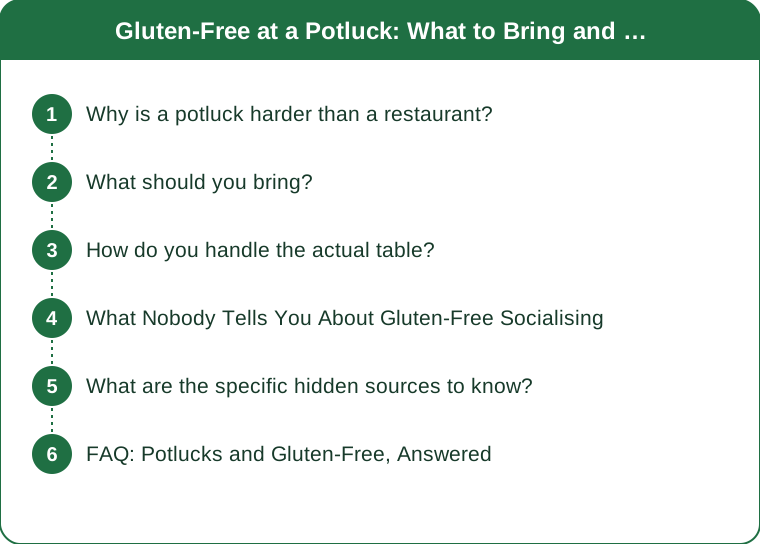
What should you bring?
One dish, chosen strategically, that guarantees you can eat regardless of everything else.
Bring something substantial, not a side. The classic mistake is bringing a gluten-free salad and then having nothing to eat but salad. Bring a main-sized dish you would be happy eating a plate of - a big grain-free traybake, a chilli, a rice or quinoa dish, a substantial roasted vegetable and protein dish.
Make it obviously good, not obviously dietary. A dish that reads as a great dish that happens to be gluten-free gets eaten and appreciated. One labelled as the gluten-free option gets left for you, which sounds convenient but marks you out and often means it is the last thing anyone tries.
Portion generously. If it is popular you want there to be some left when you go back.
Bring your own serving spoon and take it home. Small thing, and it means your dish starts clean.
Consider bringing bread or a starch base too. If everything else on the table is served with pasta, rice, or bread, having a gluten-free base means the other safe dishes become a meal rather than a plate of toppings.
Dessert is the other high-value contribution, because gluten-free dessert options at a shared table are usually nonexistent, and a good one means you are not sitting out the end of the evening.
How do you handle the actual table?
Timing and sequence do almost all the work.
Serve yourself first, before the crowd. This is the single most effective tactic. Before service starts, the spoons are in their own dishes and there are no crumbs. Offering to help set out the food gives you a natural reason to be there first.
Or plate up in the kitchen. If you have coeliac disease, this is the version that genuinely works. Ask the host quietly beforehand if you can put a plate together before it goes out. Almost every host says yes and most are glad to be told how to help.
Take from the top and centre of a dish, not the edges where the spoon has been resting.
Assume unlabelled means unsafe, and eat around it. Trying to establish the safety of eight dishes in a queue is not going to work. The dishes you brought plus obvious whole foods - plain roasted vegetables, fruit, plain meat - is a workable plate.
Do not ask the room what is in things. It puts people on the spot, produces unreliable answers, and makes the meal about your diet. Ask the host once, privately, in advance - that conversation is useful. The public version is not.
Watch out for the second wave. Dishes brought out later, or topped up, are the ones where serving spoons get swapped. Once the table has been in service for half an hour, treat everything as contaminated.
What Nobody Tells You About Gluten-Free Socialising
Hosts want to help and almost nobody tells them how. A message beforehand saying you will bring a main so there is definitely something you can eat is genuinely welcome. It removes their anxiety and yours.
Being low-key about it works better than being detailed. A short explanation lands; a long one makes people self-conscious about their own cooking, and self-conscious people over-explain and get it wrong.
People will offer you things that are not safe, repeatedly, kindly. A simple thank you, I have got plenty is complete and needs no elaboration. You do not owe anyone an explanation at a party.
The person who says a little bit will not hurt is not being malicious, they are working from a mental model of preference rather than physiology. Correcting them at the table rarely works. Not eating it does.
Eating something beforehand is a legitimate strategy and not an admission of defeat. Arriving having already had something means every decision at the table is optional, which removes the pressure entirely.
Autumn and winter are the hard season. Potlucks, office parties, holiday gatherings, and family meals all cluster from now through January. The systems you build in September carry you through December, which is a good argument for sorting this out now rather than improvising at the worst possible time of year.
What are the specific hidden sources to know?
The ones that catch people at home gatherings specifically.
Soy sauce. Standard soy sauce contains wheat. It is in marinades, stir-fries, dips, and dressings, and it is invisible. Tamari is the gluten-free version and many home cooks do not know the difference exists.
Stock cubes and gravy. Very commonly contain wheat, and gravy is frequently thickened with flour. Anything with a sauce is worth treating as unsafe unless you know otherwise.
Meatballs, burgers, and stuffings almost always use breadcrumbs as a binder.
Crispy toppings. Fried onions, some crispy coatings, and anything with a crumb layer.
Malt vinegar in dressings and pickles. Malt is barley.
Shared dips. Not the ingredients, the mechanism - one cracker double-dipped contaminates the whole bowl and there is no way to know whether it happened.
Shared butter and condiment jars at a table where bread is being buttered. Crumbs go in and stay.
Oats, unless specifically certified gluten-free - cross-contamination in milling is standard.
And the one people forget: the surface. Bread on a wooden board, the board wiped and reused, or crumbs on a counter where dishes are being set down. If you are plating in the kitchen, plate on a clean surface and it is worth asking for one.
FAQ: Potlucks and Gluten-Free, Answered
Should I tell the host in advance?
Yes, once, briefly, and pair it with a solution: mention you are gluten-free and that you will bring a substantial dish. Hosts respond well to being given a plan rather than a problem.
Is it rude to bring my own food?
At a potluck, no - bringing food is literally the format. At a hosted dinner it is worth a quick word first, but almost every host is relieved.
What if I am not coeliac, just sensitive?
The cross-contamination rules relax somewhat, but the hidden-ingredient rules do not. Soy sauce in a marinade is a full serving of gluten, not a trace.
How do I handle it if I think I have been glutened?
Leave gracefully if you need to, hydrate, and eat simply for a day or two. You do not owe an announcement. If reactions are severe or frequent, that is a conversation for your doctor - this is general information, not medical advice.
What is the best single dish to bring?
A large, well-seasoned grain or vegetable dish that eats as a main - something like a spiced rice with roasted vegetables and chickpeas. Filling, obviously appealing, travels well, and good at room temperature, which matters when it sits on a table for two hours.
TL;DR:
- A potluck removes every safeguard a restaurant has - no labels, no chef, and serving spoons that migrate within minutes.
- Bring one substantial main-sized dish, not a side, and make it good rather than obviously dietary.
- Serve yourself first, or plate up in the kitchen before service - this is the tactic that actually works.
- Assume unlabelled is unsafe and eat around it rather than interrogating the table.
- Know the hidden sources: soy sauce, stock, gravy, breadcrumb binders, malt vinegar, shared dips.
- Tell the host once, in advance, with a solution attached.
Potluck season runs from now until the new year. Build the routine at the September gatherings and December takes care of itself.
Keep Reading
This article is for general informational purposes only and is not medical advice. Always consult a qualified health professional for guidance specific to you.