Why You Still Feel Bloated on a Strict Gluten-Free Diet
Quick Answer: Persistent bloating on a strict gluten-free diet usually comes from something other than gluten: FODMAPs in gluten-free staples, the gum and starch content of processed gluten-free products, a large jump in fibre or resistant starch, or an unrelated condition such as SIBO or lactose intolerance. Accidental exposure is real but is not the most common answer.
If you have been strict for six weeks with no change, the diet is probably not the whole picture.
This is general information, not medical advice.

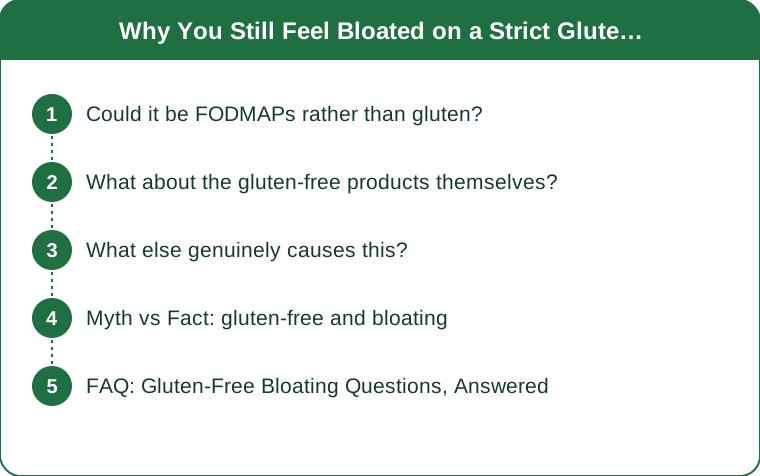
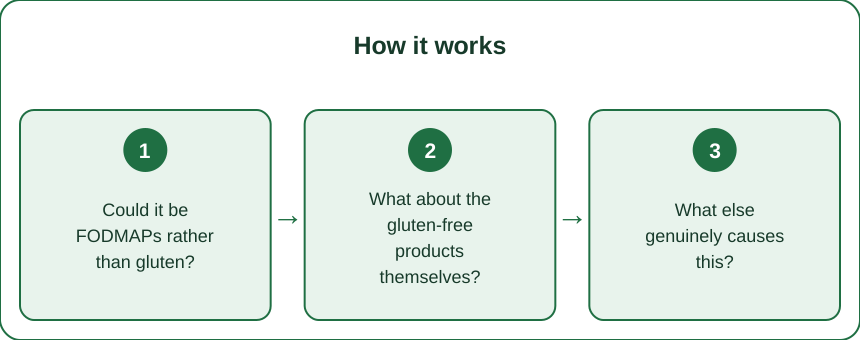
Could it be FODMAPs rather than gluten?
This is the most common explanation by some distance. Wheat contains fructans, a fermentable carbohydrate, alongside gluten. Several controlled studies in people with self-reported non-coeliac gluten sensitivity have found that fructans, not gluten, produced the symptoms.
Gluten-free does not mean fructan-free. Onion, garlic, apples, pears, legumes and many gluten-free breads contain substantial FODMAPs. It is entirely possible to remove wheat and increase total fermentable carbohydrate.
Chickpea and lentil flours are a frequent culprit. They have become popular in gluten-free pasta and crackers, and they are high in the galacto-oligosaccharides that produce gas.
The test is a structured low-FODMAP trial, ideally with a dietitian, rather than an indefinite elimination. Two to six weeks of restriction followed by systematic reintroduction identifies the trigger without permanently narrowing the diet.
What about the gluten-free products themselves?
Gums are fermentable. Xanthan, guar and inulin all appear in commercial gluten-free baking, and all three can produce gas and bloating in sensitive people at the quantities found in a couple of slices of bread.
Inulin and chicory root are the worst offenders. They are added to boost fibre content on the label and are among the most reliably gas-producing ingredients in the supermarket.
Sugar alcohols compound it. Many gluten-free snack products also use sorbitol, maltitol or xylitol, which are poorly absorbed and osmotically active.
Resistant starch from cooled products. Gluten-free bread is often refrigerated or frozen and reheated, which increases resistant starch. That is beneficial in general and gas-producing in the short term.
A useful experiment: eat only naturally gluten-free whole foods — rice, potatoes, meat, fish, eggs, low-FODMAP vegetables — for a week. If the bloating resolves, the problem is in the processed replacements rather than in gluten.

What else genuinely causes this?
Lactose intolerance frequently coexists. Damage to the small intestine in untreated coeliac disease reduces lactase production, and it can take months to recover after going gluten-free. Many people need to limit lactose temporarily.
Small intestinal bacterial overgrowth is common in coeliac disease and produces bloating that does not respond to dietary gluten removal at all. It requires diagnosis and specific treatment.
Constipation causes bloating more often than people expect. A gluten-free diet often reduces fibre intake sharply if bread and cereal were the main sources, and slower transit produces exactly this symptom.
Or fibre went up too fast in the other direction. Adding beans, brown rice and gluten-free wholegrains suddenly produces several weeks of gas while the gut microbiome adjusts. Ramping over four to six weeks avoids most of it.
And there may be a second condition entirely. Coeliac disease coexists with thyroid disease, IBS and microscopic colitis at above-average rates. Persistent symptoms after six months of strict adherence warrant a follow-up rather than more restriction.
Myth vs Fact: gluten-free and bloating
Myth: If gluten-free did not help, you were never gluten sensitive. Fact: Symptom overlap is enormous. Not responding says something about the mechanism, not about whether your symptoms are real.
Myth: Trace exposure explains persistent symptoms. Fact: For people with coeliac disease, trace exposure matters and should be investigated — but in the majority of persistent cases, the cause is a second dietary trigger rather than hidden gluten.
Myth: Gluten-free products are healthier. Fact: They are frequently lower in fibre, higher in refined starch, and more processed than their wheat equivalents. Whole-food gluten-free eating is a very different thing from packaged gluten-free eating.
Myth: Bloating means inflammation. Fact: Most bloating is gas volume and gut distension. It is uncomfortable and it is usually mechanical rather than inflammatory.
Myth: You should cut more foods until it stops. Fact: Progressive elimination without reintroduction is how people end up on very narrow diets with worse symptoms and lower fibre diversity. Structured testing beats indefinite restriction.
FAQ: Gluten-Free Bloating Questions, Answered
How long should improvement take?
With coeliac disease, symptoms often improve within weeks but full intestinal healing can take six months to two years in adults. Some ongoing symptoms during that window are expected.
Should I get tested if I already went gluten-free?
Speak to a doctor before removing gluten if possible, because both blood tests and biopsy require gluten in the diet to be accurate. If you have already stopped, testing usually requires a supervised gluten challenge.
Is bloating alone a reason to see someone?
If it is persistent, worsening, or comes with weight loss, bleeding, or anaemia, yes — promptly. Bloating on its own that has not improved after six weeks of a genuinely strict diet is also worth a professional conversation rather than further self-elimination.
TL;DR:
- Fructans and other FODMAPs in wheat, not gluten itself, drive symptoms for many people.
- Gluten-free products often contain inulin, gums and sugar alcohols that produce gas directly.
- Lactose intolerance and SIBO frequently coexist with coeliac disease and need separate treatment.
- A week of naturally gluten-free whole foods quickly shows whether the packaged replacements are the problem.
- Persistent symptoms after six weeks of strict adherence call for a professional review, not more elimination.
Still bloated is information, not failure. It usually means you removed the wrong thing.
This is general information, not medical advice.
Keep Reading
This article is for general informational purposes only and is not medical advice. Always consult a qualified health professional for guidance specific to you.