Why Weighing Your Gluten-Free Flour Changes Everything
Quick Answer: A cup of gluten-free flour blend can vary by 30 to 40 grams depending on how you scoop it, and gluten-free blends are far more sensitive to that error than wheat flour because they have no gluten network to absorb the variance. Weighing in grams eliminates the single largest source of inconsistency in gluten-free baking, and a scale that does the job costs less than two bags of flour.
If your results swing between dense and crumbly with the same recipe, the recipe is probably not the variable.
How much does a cup actually vary?
More than most people would guess, and it varies by technique as much as by flour.
The scoop-and-sweep problem. Dipping the measuring cup into the bag compacts the flour. Spooning it in lightly and leveling does not. The difference between those two techniques on a single cup of a rice-based blend can run 25 to 40 grams — roughly a 20 to 30 percent error on one ingredient.
Gluten-free blends vary more than wheat flour does. Wheat flour is a single milled ingredient with fairly consistent particle size. A gluten-free blend is a mixture of rice flour, starches, and often a gum, each with a different density. Tapioca starch is light and fluffy; brown rice flour is heavy and dense. Depending on how the bag settled in transit, the top of the bag and the bottom of the bag are not the same product by volume.
Why this matters more without gluten. In wheat baking, the gluten network is forgiving — extra flour makes a slightly tougher crumb, but the structure holds. Gluten-free structure comes from a precise balance of starch, protein, hydration and binder. Add 30 grams of extra flour and the hydration ratio shifts enough to change the outcome from tender to dry, or gummy to crumbly.
The compounding effect. A recipe with three cups of flour and a 25-gram error per cup is off by 75 grams — most of an extra half cup.
What should you actually weigh?
Everything dry, plus the sticky things. Everything else can stay in cups.
Weigh without exception:
- Flour blends and individual flours
- Starches (tapioca, potato, cornstarch)
- Sugar, especially brown sugar, where packing varies enormously
- Cocoa powder, which is one of the worst offenders for volume error
Weigh because it is easier, not because it is more accurate:
- Honey, molasses, nut butter — weighing them straight into the bowl means no sticky measuring cup
- Yogurt and sour cream, for the same reason
Do not bother weighing:
- Water and milk, where 1ml is close enough to 1 gram for baking purposes
- Salt, baking powder, baking soda, xanthan gum — these are measured in small enough quantities that a level teaspoon is reliable, and most home scales are not precise enough at 2 grams to be an improvement
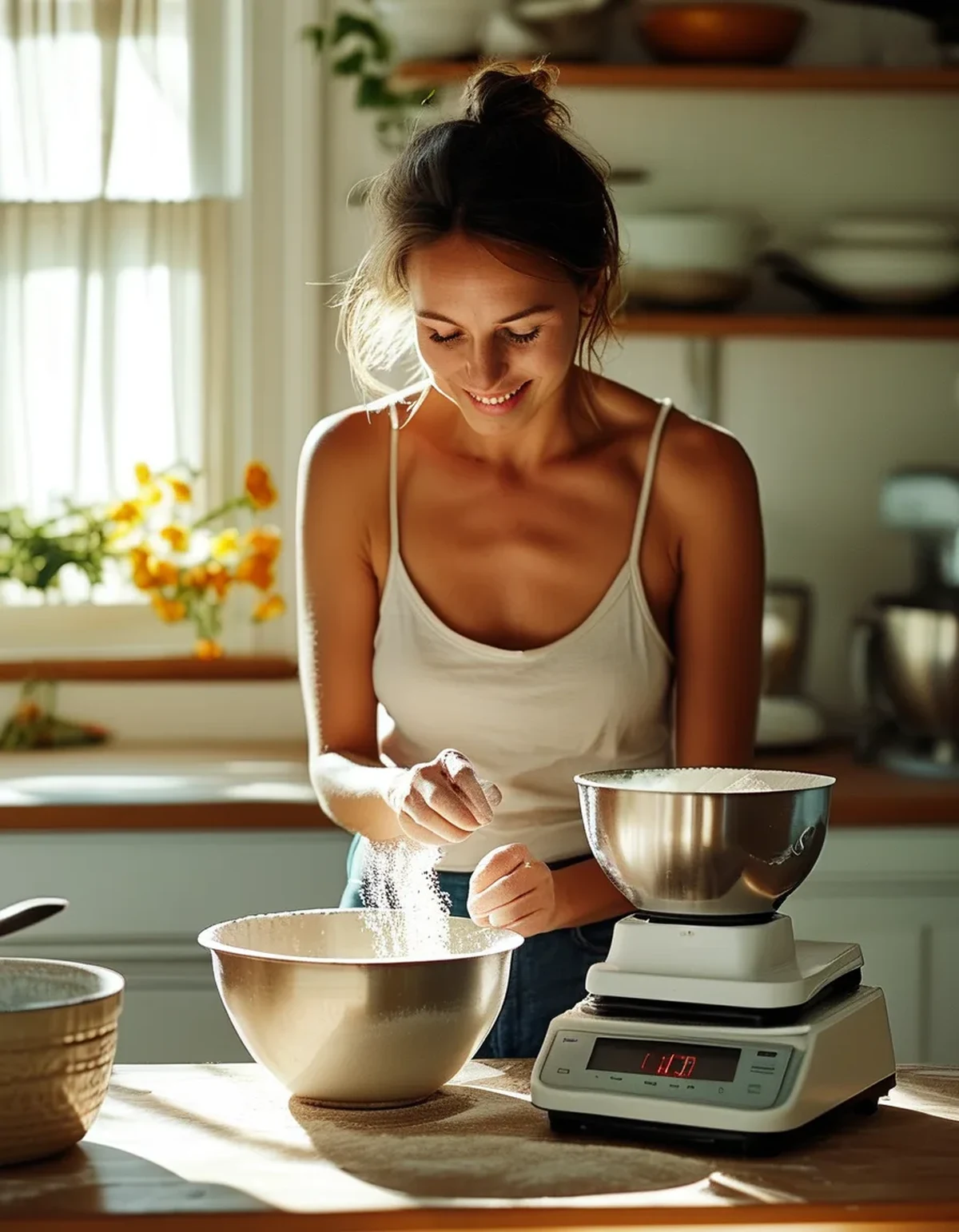
The workflow that saves time: put the bowl on the scale, tare, add ingredient one, tare, add ingredient two. One bowl, no measuring cups, less washing up. Most people find weighing faster than measuring within a week.

Myth vs Fact: gluten-free measuring
Myth: If the recipe was written in cups, weighing will not help.
Fact: Weighing still helps, because it makes your results consistent batch to batch. Weigh the cups once using the recipe’s stated method, write the grams on the recipe, and every future batch matches. You have converted the recipe permanently.
Myth: All gluten-free flour blends weigh the same per cup.
Fact: Common blends range from roughly 120 to 160 grams per cup. Substituting one brand for another by volume can shift the flour content by a quarter without you touching the recipe — which is the real reason a recipe that worked with one bag fails with the next.
Myth: Sifting fixes the density problem.
Fact: Sifting standardizes aeration somewhat but not reliably, and it does nothing about brand-to-brand density differences. It also does not survive the trip from sifter to cup.
Myth: A scale is fussy and slows baking down.
Fact: Tare-as-you-go into one bowl is measurably faster than filling, leveling and washing four measuring cups. The fussiness is entirely in the anticipation.
What does a converted recipe look like?
Useful reference weights for the common gluten-free ingredients, per US cup, spooned and leveled.
- All-purpose gluten-free blend: 120 to 160g depending on brand — check the bag, most now print it
- Almond flour: about 96g
- Brown rice flour: about 158g
- White rice flour: about 158g
- Tapioca starch: about 120g
- Potato starch: about 160g
- Coconut flour: about 112g, and the most hydration-sensitive of the group
- Oat flour (certified GF): about 92g
- Granulated sugar: 200g
- Brown sugar, packed: 213g
- Cocoa powder: about 85g
How to convert your own working recipe: the next time you bake it and it comes out right, weigh each dry ingredient as you add it and write the number down. That single batch converts the recipe permanently and is far more reliable than a generic chart, because it captures your flour, your technique and your bag.
Note on coconut flour specifically: it absorbs several times its weight in liquid and a 10-gram error is enough to change the outcome. If you bake with it at all, a scale stops being optional.
FAQ: Gluten-Free Measuring Questions, Answered
What kind of scale do I need?
A basic digital kitchen scale reading in 1-gram increments up to about 5kg, with a tare button. Nothing more is required for baking. Precision at the sub-gram level only matters for very small quantities, which you are measuring by spoon anyway.
My recipe is in ounces, not grams. Is that fine?
It works, but grams give better resolution — an ounce is about 28 grams, so ounce measurements to one decimal place are coarser than whole grams. Most scales switch units with one button, so use grams for baking and ounces for whatever else you like.
Does this matter as much for savory cooking?
Much less. Baking is chemistry with fixed ratios; a stew tolerates a wide range. The place weighing pays off outside baking is anything with a dough or batter — pancakes, coating mixes, pasta.
TL;DR:
- Scoop-and-sweep versus spoon-and-level can change a cup of gluten-free flour by 25 to 40 grams.
- Gluten-free blends mix ingredients of very different densities, so volume error is larger than with wheat flour.
- Without gluten there is no forgiving network, so hydration ratio errors show up directly in the crumb.
- Weigh flours, starches, sugar and cocoa; cups are fine for liquids and small leaveners.
- Convert your own working recipes by weighing the batch that comes out right.
A scale is the cheapest upgrade in gluten-free baking, and it fixes the failure mode that no amount of recipe hunting will.
Keep Reading
This article is for general informational purposes only and is not medical advice. Always consult a qualified health professional for guidance specific to you.