What Those Gluten-Free Certification Symbols on Packaging Actually Mean
Quick Answer: A plain ‘gluten-free’ claim on packaging means the product meets a legal threshold (typically under 20ppm in the US), but third-party certification symbols like the Gluten-Free Certification Organization (GFCO) mark involve independent testing and stricter thresholds, offering an extra layer of verification for sensitive individuals.
You’ve probably noticed some gluten-free products have an official-looking certification stamp while others just print ‘gluten-free’ in plain text. That difference matters more than most shoppers realize.

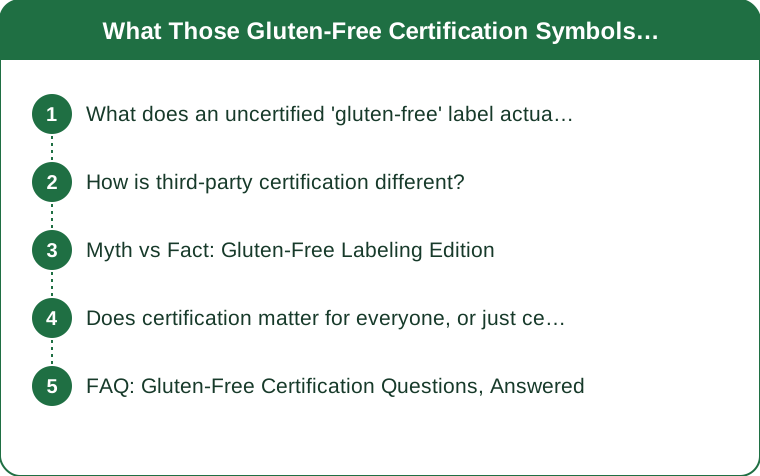
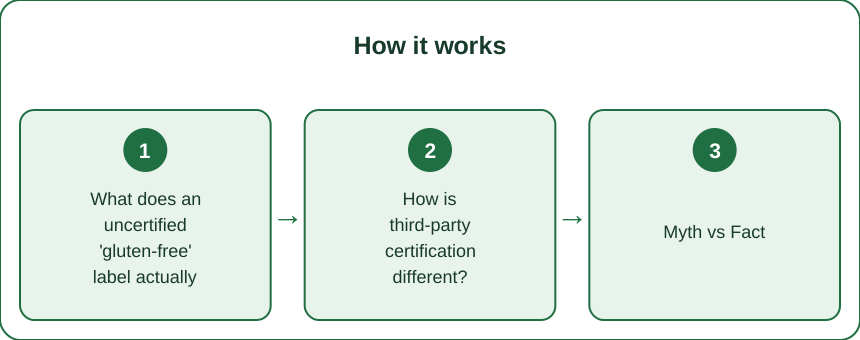
What does an uncertified ‘gluten-free’ label actually guarantee?
In the US, the FDA requires that any product labeled ‘gluten-free’ contain less than 20 parts per million (ppm) of gluten — this is a legal requirement, and companies are responsible for their own compliance, though the FDA can audit and enforce it.
This threshold is considered safe for the vast majority of people with celiac disease, but it relies on the manufacturer’s own testing and processes rather than an independent third party verifying it batch by batch.
How is third-party certification different?
Organizations like GFCO test products independently and often require a lower threshold (10ppm) than the legal minimum, plus regular facility audits and ongoing testing rather than a one-time claim.
This matters most for people with celiac disease or high sensitivity, where the gap between 10ppm and 20ppm can be the difference between comfortable and symptomatic, even though both technically qualify as ‘gluten-free’ under the law.

Myth vs Fact: Gluten-Free Labeling Edition
Myth: All gluten-free labels are independently verified. Fact: only certified products (with an official symbol like GFCO’s) undergo third-party testing — plain label claims are self-reported by the manufacturer.
Myth: Certification symbols are just marketing. Fact: certification involves real facility audits and regular product testing, which is a meaningful process difference, not just a logo.
Myth: A product without certification is automatically less safe. Fact: many smaller or newer brands simply haven’t pursued (often costly) certification yet, despite genuinely meeting gluten-free standards — certification absence isn’t proof of a problem, just less independent verification.
Does certification matter for everyone, or just celiac disease?
For people with celiac disease or very high gluten sensitivity, certification’s stricter threshold and audit process provides meaningful extra assurance. For people avoiding gluten for general wellness reasons without diagnosed sensitivity, the legal 20ppm threshold is typically more than sufficient.
Knowing your own sensitivity level is the real deciding factor — certification isn’t necessary for everyone, but it’s genuinely valuable for those who need it.
FAQ: Gluten-Free Certification Questions, Answered
What does the GFCO symbol actually look like?
It’s a specific logo (a stylized wheat stalk with a line through it, alongside ‘GFCO’ text) printed on certified packaging — distinct from generic ‘gluten-free’ text claims.
Are certified gluten-free products more expensive?
Often slightly, since certification involves ongoing costs for the manufacturer (testing, audits), which can factor into pricing, though not always significantly.
Can a product be cross-contaminated even with certification?
Certification significantly reduces this risk through facility audits, but no system is 100% foolproof — people with severe sensitivity should still watch for reactions and report them.
TL;DR:
- A plain ‘gluten-free’ label meets a legal threshold (under 20ppm in the US) based on manufacturer self-reporting
- Third-party certification (like GFCO) involves independent testing, often at a stricter 10ppm threshold
- Certification matters most for celiac disease or high sensitivity, less for general wellness avoidance
- Absence of certification doesn’t mean a product is unsafe — just less independently verified
If you react to trace gluten even in labeled products, look specifically for the certification symbol next time, not just the words ‘gluten-free.’
Keep Reading
This article is for general informational purposes only and is not medical advice. Always consult a qualified health professional for guidance specific to you.