What 'Gluten-Free' on a Label Actually Guarantees (It's Not Zero Gluten)
Quick Answer: In the US, a “gluten-free” label legally means the product contains less than 20 parts per million (ppm) of gluten, not zero gluten — this threshold was set based on research suggesting most people with celiac disease can tolerate trace amounts below that level without symptoms, but it’s a regulated maximum, not a guarantee of complete absence.

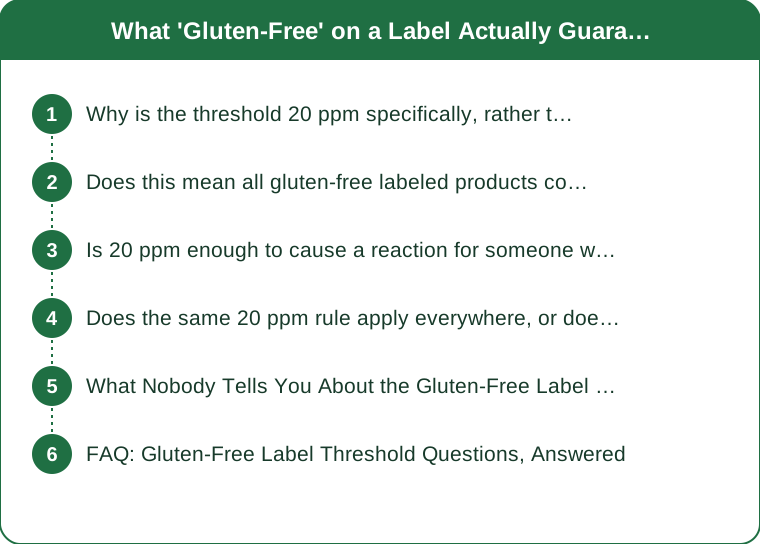
Why is the threshold 20 ppm specifically, rather than zero?
Research used to set the FDA’s gluten-free labeling rule found that most people with celiac disease do not show a measurable immune reaction to gluten below roughly 20 ppm, and setting the standard at true zero was considered both scientifically unnecessary for most celiac patients and practically very difficult for food manufacturers to guarantee given how gluten cross-contamination can occur even in dedicated facilities.
Does this mean all gluten-free labeled products contain measurable gluten?
Not necessarily — many gluten-free products test at or near zero, but the label’s legal requirement only guarantees they’re under the 20 ppm ceiling, not that they contain literally no detectable gluten. Products made in shared facilities with wheat-containing items are more likely to be closer to that ceiling than a dedicated gluten-free facility product.
Is 20 ppm enough to cause a reaction for someone with celiac disease?
For the majority of people with celiac disease, research suggests this level doesn’t trigger a measurable immune response, but individual sensitivity varies, and a small subset of highly sensitive celiac patients report symptoms even at levels within the legal threshold — this is part of why some people with celiac disease seek out products specifically labeled or tested well below 20 ppm.

Does the same 20 ppm rule apply everywhere, or does it vary by country?
Thresholds vary internationally — the EU, for instance, uses a similar 20 ppm standard for “gluten-free” but has a separate, higher “very low gluten” category at 100 ppm, while other countries have their own specific regulatory frameworks, so the exact number isn’t universal across every label you might encounter.
What Nobody Tells You About the Gluten-Free Label Threshold
Certified gluten-free labels (from third-party certifying organizations) sometimes use a stricter threshold than the government minimum, testing to below 10 ppm in some certification programs — checking for a specific certification logo, not just the words “gluten-free” on the package, gives an extra layer of assurance for more sensitive individuals.
Cross-contamination risk during manufacturing is the main reason products near the ceiling exist at all — a facility that also processes wheat products, even with careful protocols, carries more risk of trace contamination than a fully dedicated gluten-free facility, which is reflected in why some brands invest in dedicated production lines specifically to market a stricter guarantee.
The 20 ppm standard is specifically about celiac disease research, not necessarily about non-celiac gluten sensitivity, which is a less precisely defined condition with less standardized threshold research behind it — someone with gluten sensitivity (rather than diagnosed celiac disease) may have a different personal tolerance that doesn’t map directly onto the celiac-focused regulatory threshold.
FAQ: Gluten-Free Label Threshold Questions, Answered
How can I find products tested below the standard 20 ppm threshold?
Looking for third-party certification logos (rather than just the words “gluten-free”) is the most reliable way, since some certification programs test to a stricter standard than the government minimum.
Does a product made in a facility that also processes wheat automatically exceed 20 ppm?
Not automatically — many shared facilities have protocols and testing that keep products within the legal threshold, but the risk profile is generally higher than a fully dedicated facility.
Should someone newly diagnosed with celiac disease be concerned about the 20 ppm threshold?
Most newly diagnosed patients tolerate products within the standard threshold without issue, though discussing individual sensitivity and any specific concerns with a doctor or dietitian is worthwhile, especially in the first months after diagnosis. This is general information, not medical advice.
TL;DR:
- “Gluten-free” legally means under 20 ppm of gluten in the US, not zero gluten
- This threshold is based on research suggesting most celiac patients don’t react below that level
- Third-party certification logos sometimes guarantee a stricter threshold than the legal minimum
- Shared manufacturing facilities carry more cross-contamination risk than fully dedicated ones
The label is a real, regulated promise — just not the absolute-zero guarantee most people assume it to be.
Keep Reading
This article is for general informational purposes only and is not medical advice. Always consult a qualified health professional for guidance specific to you.