Ordering Gluten-Free Without the Table Cringe: Restaurant Scripts
Quick Answer: Match your opener to your severity. Celiac: “I have celiac — is the kitchen able to do gluten-free safely?” The quality of the answer tells you everything in about ten seconds. Preference or sensitivity: “Which dishes are gluten-free as-is?” Then ask the fryer question, skip the apology preamble entirely, and build a roster of three verified-safe local spots you can order at without thinking.
There’s a specific dread that arrives right before you order. The table goes quiet. You imagine the server’s internal sigh. Someone’s already looking at you.
The dread is almost entirely manufactured, and it dissolves the moment you have words ready. Not a speech — a sentence. Kitchens accommodate clarity cheerfully and guesswork grudgingly, which means the script isn’t just for you. It’s for them too.
Here are the exact phrases, the cuisines that make it easy, and the one question that separates a safe kitchen from a risky one faster than anything else.

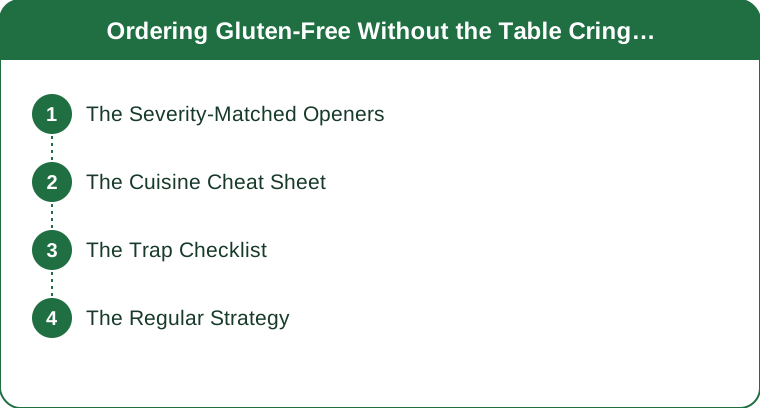
What Should You Say to a Server When Ordering Gluten-Free?
Match the opener to your actual situation. These are two different conversations and running the wrong one causes most of the friction.
If you have celiac disease:
“I have celiac — is the kitchen able to do gluten-free safely?”
The response quality is the answer, and it arrives in about five seconds. Confident specifics — “yes, we have a separate prep area, let me flag it for the kitchen” — means someone there has thought about this before. Vague reassurance — “yeah, should be fine, most stuff is” — means nobody has, and you should order something naturally low-risk or go somewhere else.
If it’s a sensitivity or a preference:
“Which dishes are gluten-free as-is?”
This is a fast, easy question for a server to answer, and as-is is the load-bearing phrase — it skips the whole modification conversation and gets you straight to the workable list.
And in both cases: no apology preamble. Not “sorry, I know this is annoying, but…” You’re a customer stating a requirement, the same as someone ordering a steak medium-rare. The apology is what makes it feel like an imposition — to you and to everyone at the table. Delivered breezily, it’s just an order.
Which Cuisines Are Easiest for Gluten-Free Dining?
Choosing the restaurant is the highest-leverage decision, and you make it before you’re hungry, when your judgment is best.
Naturally gluten-free-deep menus:
- Mexican — corn tortillas, beans, rice, grilled meats. Check that the tortillas are 100% corn, not a corn-wheat blend, and watch flour-tortilla cross-contact.
- Thai and Vietnamese — rice noodles throughout. Ask about soy sauce and oyster sauce; fish sauce is usually fine, and many kitchens will sub tamari.
- Steakhouses — protein and vegetables, minimal flour, and usually a staff that handles special requests routinely.
- Indian — most curries are thickened with onion, tomato, or cream rather than flour. Avoid naan and anything battered; rice and dosa are your friends.
The minefields:
- Pasta places — though dedicated gluten-free pasta is increasingly common, and worth calling ahead about.
- Pubs and anything breaded — shared fryers make this hard even when a dish sounds safe.
- Soy-sauce-based kitchens without tamari — Chinese and Japanese restaurants vary enormously here. Some are excellent; some use soy in everything.

What Are the Hidden Sources of Gluten in Restaurant Food?
The dish is rarely the problem. The invisible carriers are.
- Soy sauce — wheat-based unless it’s specifically tamari. It hides in marinades, dressings, and glazes on things that look nothing like Asian food.
- Shared fryers — the single biggest trap. Fries are gluten-free; fries cooked in the oil that just fried breaded chicken are not.
- Soup and sauce thickeners — a roux is flour, and it’s in more sauces than most menus mention.
- Croutons arriving by default — salads get topped at the pass, and “no croutons” said after the fact means a remake or a plate you can’t eat.
- Marinades and spice blends — pre-mixed seasonings sometimes contain wheat as a flow agent.
The two-line insurance policy, both asked breezily and answered instantly:
“Is the fryer shared?” “No croutons, please.”
The fryer question is the most diagnostic thing you can ask. It’s specific enough that only a kitchen that has genuinely thought about cross-contact will have a real answer, and it takes four words.
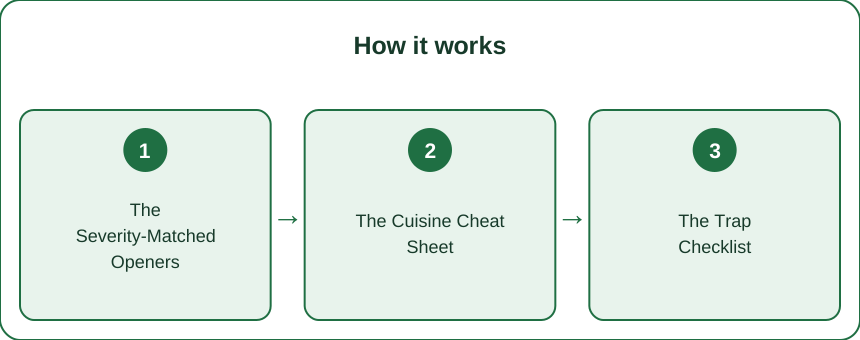
What Nobody Tells You About Eating Out Gluten-Free
Timing beats phrasing. Call at 3pm on a Tuesday, not at 7:30 on a Saturday. A kitchen with time will tell you exactly what they can do; the same kitchen mid-rush will give you the fast, vague answer.
Become a regular somewhere. Build a roster of three verified-safe local spots and go often enough to be recognized. Regulars get remembered accommodations, zero-effort ordering, and a kitchen that already knows. Three reliable places removes about 80% of the total stress of eating out — the exhausting part was never any single meal, it was the constant re-evaluation.
Ordering last is a small advantage. By then the server has settled, the table has stopped listening, and you get a normal conversation instead of a performance.
“Gluten-friendly” is not “gluten-free.” Some restaurants use that phrasing specifically to signal they can’t guarantee cross-contact control. It’s an honest disclaimer, and it’s worth taking seriously if you have celiac.
Your reaction is data, not a verdict on the restaurant. If you get sick after a meal somewhere that seemed careful, note it and don’t return, but don’t spend the evening reconstructing which dish did it. And if reactions are frequent or severe despite careful ordering, that’s worth raising with your doctor or a dietitian — persistent symptoms on a well-managed gluten-free diet sometimes point at something else.
Mini FAQ
Do you have to tell the server you have celiac?
If you have celiac, yes — it changes how the kitchen handles your order, and it’s the difference between avoiding an ingredient and avoiding cross-contact. Servers are trained to escalate the word “celiac” in a way they aren’t trained to escalate “no gluten.”
What’s the single best question to ask a restaurant?
“Is the fryer shared?” It’s fast, it’s specific, and only a kitchen that has actually thought about cross-contact will have a confident answer. The quality of the response tells you as much as the content.
How do you handle group meals when you can’t eat most of the menu?
Volunteer to pick the restaurant. It sounds like taking on work, and it’s actually the easiest path — nobody objects to someone else making the reservation, and you get to choose from your safe roster instead of negotiating in real time at a place that can’t help you.
TL;DR:
- Match the opener to your severity; celiac gets the safety question, sensitivity gets “which dishes are gluten-free as-is?”
- Drop the apology preamble — it’s what makes a normal request feel like an imposition.
- Favor Mexican, Thai, Vietnamese, Indian, and steakhouses; be cautious at pubs, pasta places, and soy-heavy kitchens.
- Ask the fryer question. It’s four words and the most diagnostic thing you can say.
- Build a roster of three verified-safe local spots and become a regular — that removes most of the ongoing stress.
Match the opener to your severity, favor the friendly cuisines, ask about the fryer, cultivate three home bases. The table cringe was always optional — clarity ordered breezily reads as confidence, because that’s exactly what it is.
Keep Reading
This article is for general informational purposes only and is not medical advice. Always consult a qualified health professional for guidance specific to you.