Why Gluten-Free Doughs Behave Differently When the Kitchen Cools
Quick Answer: Yeast activity is highly temperature-dependent and slows substantially as the room cools, so the same rise time produces a much smaller loaf in an 18°C kitchen than in a 26°C one. Gluten-free doughs are hit harder than wheat doughs because their structure relies on starch gelatinisation and binders rather than a gluten network, leaving less tolerance for under-proofing. Fix the dough temperature, not the recipe - aim for a final dough temperature around 25 to 27°C and proof somewhere genuinely warm.
Same flour blend, same yeast, same measurements, same oven. In July it came out of the tin with a domed top. In October it is a flat, dense brick and you have started suspecting the flour.

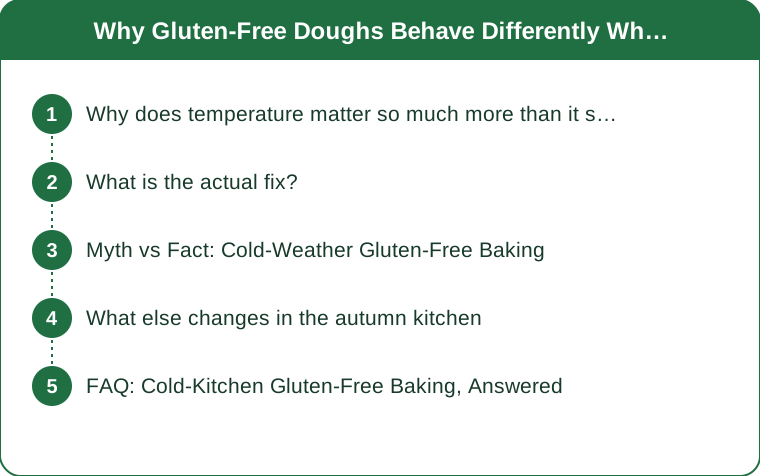
Why does temperature matter so much more than it seems to?
Because two temperature-sensitive processes are doing all the work, and both slow down together.
Yeast activity roughly follows a temperature curve with a clear optimum. Yeast ferments most actively somewhere in the region of 25 to 30°C, slows markedly as temperature falls, and becomes very sluggish below about 15°C. A kitchen that was 26°C in August and is 18°C in October is not slightly slower - it can be dramatically slower, easily doubling or more the time needed for the same rise.
Most recipes specify a time, not a state. Rise for one hour is a summer instruction. In a cooler kitchen the correct instruction is rise until roughly doubled, however long that takes - and it might be well over two hours.
Ingredient temperature compounds it. Flour stored in a cold pantry, eggs straight from the fridge, and liquid measured lukewarm rather than genuinely warm all pull the final dough temperature down. The dough starts cold, warms only slowly in a cool room, and spends much of its proof below optimal.
Gluten-free doughs have less margin for this than wheat doughs. In wheat baking, the gluten network provides an elastic structure that traps gas and can hold shape through imperfect proofing. Gluten-free baking builds structure from starch gelatinisation during baking plus binders such as psyllium or xanthan, and it relies more on getting adequate gas production before the bake. Under-proofed gluten-free dough has no fallback structure to save it.
And gluten-free batters are usually wetter, which means more thermal mass and even slower warming from a cold start.
One thing that gets better in the cold, worth knowing: slower fermentation develops more flavour. A long cool proof produces a more complex loaf. The trick is proofing to the right state rather than fighting the clock.
What is the actual fix?
Control the dough temperature directly rather than hoping the room cooperates.
Target a final dough temperature of roughly 25 to 27°C immediately after mixing. An instant-read thermometer in the dough takes five seconds and turns guesswork into a number.
Warm the liquid rather than the room. Use liquid at around 40 to 43°C - noticeably warm to the touch but not hot. Above roughly 50°C you begin damaging yeast, so this is one place where the thermometer earns its keep.
Bring ingredients to room temperature first. Eggs out of the fridge an hour ahead, or warmed briefly in a bowl of warm water. Flour blends stored somewhere cold benefit from sitting in the kitchen for an hour.
Warm the bowl and the tin. Rinsing both with hot water and drying them removes a surprising amount of heat loss from a cool dough.
Create a proofing box. Oven with the light on and the door closed usually holds a suitable temperature - check with a thermometer, because some ovens run warmer than ideal. Alternatively, a bowl of just-boiled water in a closed oven or microwave alongside the dough produces a warm, humid environment that also prevents surface drying.
Proof to state, not to time. Gluten-free dough usually will not double in the dramatic way wheat dough does, so use a visual mark on the tin and a target of around fifty to seventy percent increase depending on the recipe.
Cover to keep humidity in. Cool dry autumn air forms a skin on the dough surface, which restricts rise and produces a tough crust. A shower cap over the tin, or oiled cling film, solves it.
And be careful about over-correcting. Proofing somewhere genuinely hot - on a radiator, in an oven that is warmer than it looks - runs the dough too fast, produces off flavours, and can over-proof and collapse. Warm, not hot, is the target.

Myth vs Fact: Cold-Weather Gluten-Free Baking
Myth: The recipe stopped working. Fact: The recipe never accounted for room temperature, which is the variable that changed. Almost every home baking recipe is silently calibrated to a comfortable kitchen, and a difference of eight degrees is enough to change the outcome completely.
Myth: Add more yeast to compensate for the cold. Fact: More yeast produces faster fermentation but also more yeasty flavour, and it does not address the underlying issue, which is that the dough is too cold for the yeast you already have to work well. Warming the dough is the direct fix; adding yeast is a workaround with side effects.
Myth: Gluten-free dough should double like wheat dough. Fact: Most gluten-free doughs rise less dramatically, because there is no elastic gluten network to expand and hold. Waiting for a doubling that will never come is a common route to over-proofed, collapsed loaves. Use the recipe’s stated target or a mark on the tin.
Myth: A longer rise always means a better loaf. Fact: Longer at the right temperature develops flavour. Longer because the dough is too cold means the yeast is producing gas inefficiently and the structure may degrade before adequate rise is achieved. Cold-proofing in the fridge deliberately is a technique; cold-proofing accidentally on the worktop is a problem.
Myth: Autumn humidity makes gluten-free flour behave differently. Fact: Flour does take up and give off moisture with ambient humidity, and gluten-free blends containing very absorbent components can be sensitive to it - so hydration may need small adjustment. But it is a much smaller effect than temperature, and people usually blame it first because it is less obvious.
What else changes in the autumn kitchen
A few smaller factors that add up once you have solved the main one.
Ingredient storage temperature. Flour blends, particularly those containing nut or seed flours with higher fat content, are often stored in a fridge or freezer to prevent rancidity. Straight from cold storage they will pull the dough temperature down sharply. Weigh them out an hour ahead.
Hydration drifts with ambient humidity. As indoor heating dries the air, flour gives up some moisture, and a dough that was perfect in August can feel stiffer with the same liquid quantity. Adjust by feel in small increments - a tablespoon at a time - rather than changing the recipe permanently.
Butter and fat behave differently in a cool kitchen. A recipe calling for softened butter means genuinely soft, and in an 18°C room butter does not soften on the counter in ten minutes the way it did in August. Under-softened fat does not cream properly, which changes texture in cakes and enriched doughs.
Cooling takes longer, which is helpful. Gluten-free baked goods need to cool completely before slicing, because their structure is still setting as they cool - slicing warm produces a gummy interior. Cooler kitchens shorten that wait slightly, and it is one seasonal advantage.
Oven behaviour can shift too. A cold kitchen means a colder oven cavity at the start, and ovens in cold rooms lose heat faster when the door opens. Preheat longer than usual, and open the door as little as possible.
And storage improves. Gluten-free bread stales quickly, largely through starch retrogradation, and that process is actually fastest at refrigerator temperatures - which is why the fridge is the worst place to store bread. A cool room is fine, and slicing and freezing what you will not eat within a day remains the best answer year round.
FAQ: Cold-Kitchen Gluten-Free Baking, Answered
Why is my gluten-free bread not rising in autumn?
Almost always dough temperature. Yeast ferments most actively around 25 to 30°C and slows sharply as things cool, so the same one-hour rise in an 18°C kitchen produces a fraction of the gas it did at 26°C. Warm the liquid, warm the bowl, and proof somewhere genuinely warm rather than extending the time on a cold worktop.
What temperature should gluten-free dough be?
Aim for a final dough temperature of about 25 to 27°C right after mixing, measured with an instant-read thermometer. Use liquid at around 40 to 43°C to get there - warm to the touch, not hot, since temperatures much above 50°C start damaging yeast.
Should gluten-free dough double in size?
Usually not. Without a gluten network to expand and hold, most gluten-free doughs rise noticeably less than wheat doughs. Waiting for a doubling that is not coming is a common cause of over-proofed, collapsed loaves - use the recipe’s target or mark the tin and aim for a set increase.
Can I just add more yeast when the kitchen is cold?
You can, but it treats the symptom and adds a yeasty flavour. The dough is not short of yeast, it is too cold for the yeast to work efficiently. Raising dough temperature addresses the actual mechanism and gives a better-tasting result.
How should I store gluten-free bread?
Not in the fridge - starch retrogradation, the main cause of staling, actually runs fastest at fridge temperatures. Keep what you will eat within a day at room temperature in a sealed bag, and slice and freeze the rest, toasting straight from frozen.
TL;DR:
- Yeast slows dramatically as the kitchen cools; the recipe’s rise time was written for a warm room.
- Gluten-free dough has no gluten network to rescue an under-proof, so it suffers more than wheat dough.
- Target 25 to 27°C final dough temperature, using liquid at 40 to 43°C and a warmed bowl.
- Proof to state with a mark on the tin, not to the clock - and expect less than doubling.
- Cover the dough; dry autumn air forms a skin that restricts rise.
The flour is fine. The kitchen is eight degrees colder than it was, and that is the entire recipe change.
Keep Reading
This article is for general informational purposes only and is not medical advice. Always consult a qualified health professional for guidance specific to you.